Publications

Published under the name Jurijs Nazarovs. Also on Google Scholar ↗.

2026

2026

Grounded Human-Attributed Description and Activity Recognition in Videos (GHADAR)

Jurijs Nazarovs et al.

ECCV 2026 (under review)

Abstract

We introduce GHADAR, the task of per-person, open-set attribute and activity description in multi-person videos, together with AVA-Captions — the first large-scale grounded dataset of this kind, built by extending AVA-Actions with VLM-generated captions and identity-aware deduplication. We propose CAMP (Constrained Attention Masking-based Pretraining), a two-stage VLM training strategy that explicitly leverages grounding through attention-mask constraints and outperforms state-of-the-art VLMs, alongside a VLM-driven evaluation framework that compares video and prediction at the concept level rather than via n-gram or embedding metrics.

BibTeX
@inproceedings{nazarovs2026ghadar,
  title     = {Grounded Human-Attributed Description and Activity Recognition in Videos (GHADAR)},
  author    = {Nazarovs, Jurijs and others},
  booktitle = {Under review at the European Conference on Computer Vision (ECCV)},
  year      = {2026}
}
2023

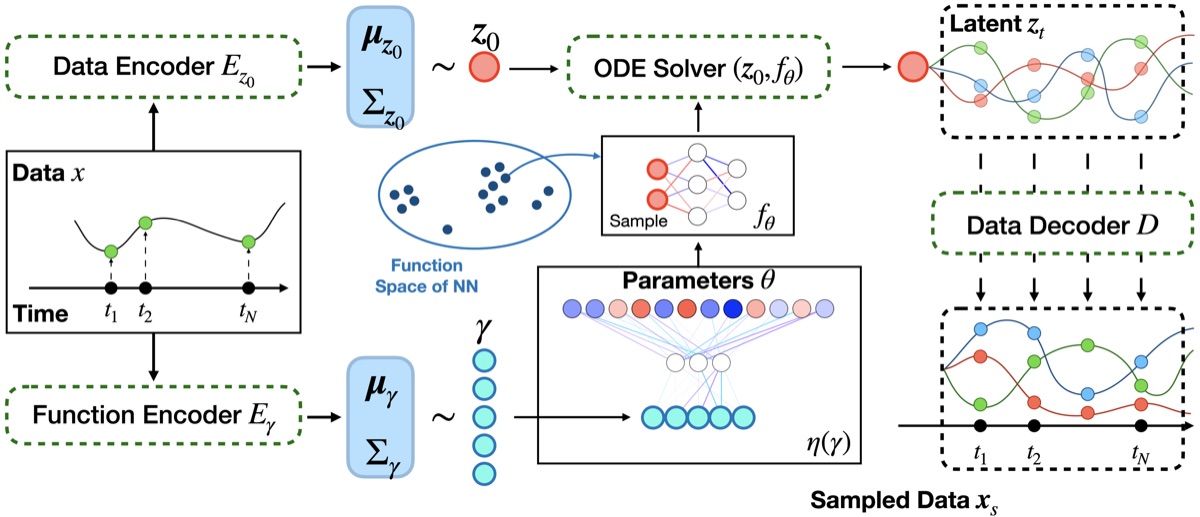
Variational Sampling of Temporal Trajectories — teaser figure

Variational Sampling of Temporal Trajectories

Jurijs Nazarovs, Zhichun Huang, Xingjian Zhen, Sourav Pal, Rudrasis Chakraborty, Vikas Singh

Preprint

Abstract

A deterministic temporal process can be determined by its trajectory, an element in the product space of an initial condition and a transition function. We introduce a mechanism to learn the distribution of trajectories by parameterizing the transition function explicitly as an element in a function space. The framework allows efficient synthesis of novel trajectories while directly providing tools for inference — uncertainty estimation, likelihood evaluation, and out-of-distribution detection for abnormal trajectories.

BibTeX
@article{nazarovs2023variational,
  title   = {Variational Sampling of Temporal Trajectories},
  author  = {Nazarovs, Jurijs and Huang, Zhichun and Zhen, Xingjian and
             Pal, Sourav and Chakraborty, Rudrasis and Singh, Vikas},
  journal = {arXiv preprint arXiv:2403.11418},
  year    = {2023}
}

2022

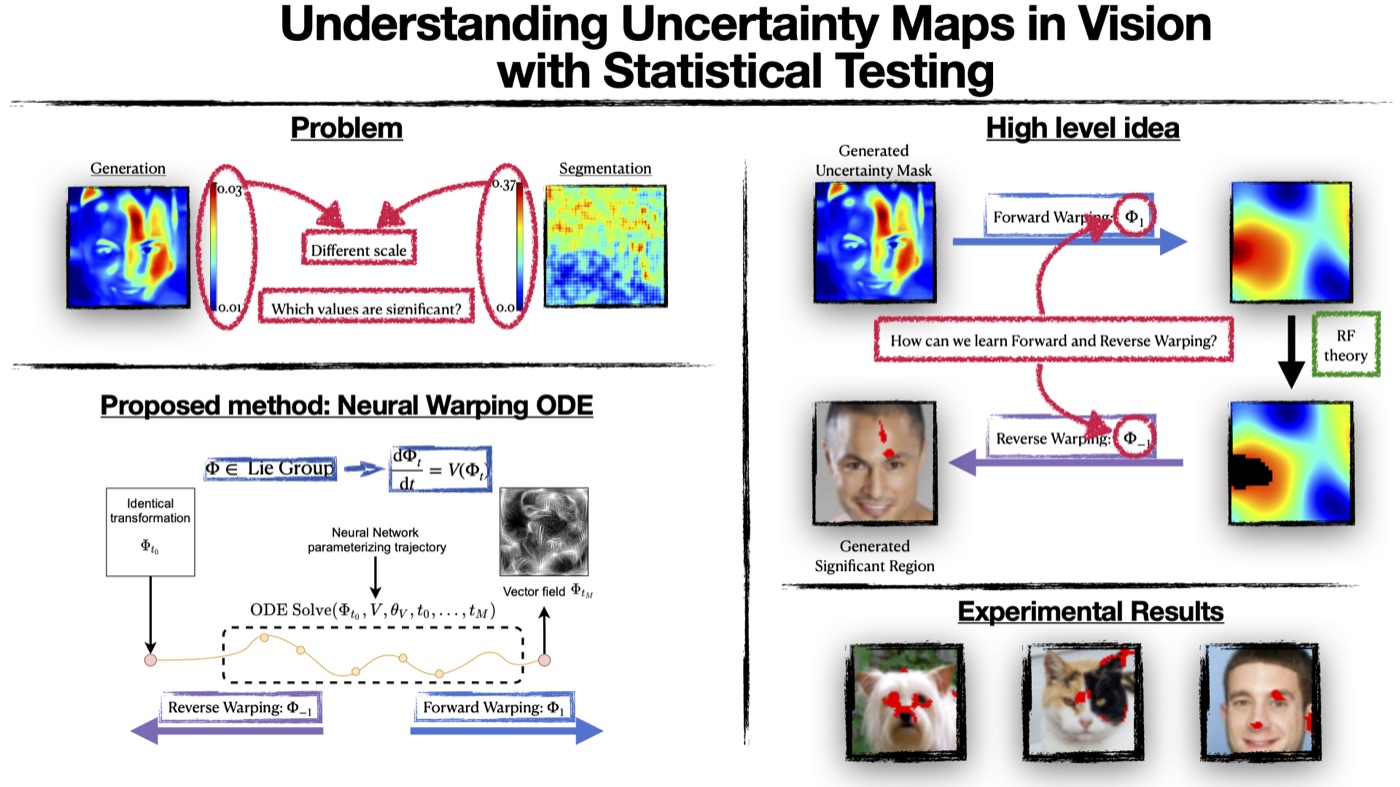
Understanding Uncertainty Maps in Vision with Statistical Testing — teaser figure

Understanding Uncertainty Maps in Vision with Statistical Testing

Jurijs Nazarovs, Zhichun Huang, Songwong Tasneeyapant, Rudrasis Chakraborty, Vikas Singh

CVPR 2022

Abstract

Quantitative descriptions of confidence intervals and uncertainties are needed in many vision and machine learning applications. We show how revisiting results from Random Field Theory, paired with deep neural network tools, leads to efficient frameworks that provide hypothesis-testing capabilities for uncertainty maps from models used in many vision tasks.

BibTeX
@inproceedings{nazarovs2022understanding,
  title     = {Understanding Uncertainty Maps in Vision with Statistical Testing},
  author    = {Nazarovs, Jurijs and Huang, Zhichun and Tasneeyapant, Songwong and
               Chakraborty, Rudrasis and Singh, Vikas},
  booktitle = {Proceedings of the IEEE/CVF Conference on Computer Vision and Pattern Recognition (CVPR)},
  year      = {2022}
}
Image2Gif: Generating Continuous Realistic Animations with Warping NODEs — teaser figure

Image2Gif: Generating Continuous Realistic Animations with Warping NODEs

Jurijs Nazarovs, Zhichun Huang

AI4CC Workshop, CVPR 2022

Abstract

We propose Warping Neural ODE, a framework for generating smooth animations (video frame interpolation) in a continuous manner given two far-apart frames. By using continuous spatial transformation of the image based on a vector field derived from a system of differential equations, the method achieves smooth, realistic animations with infinitely small time steps between frames.

BibTeX
@inproceedings{nazarovs2022image2gif,
  title     = {Image2Gif: Generating Continuous Realistic Animations with Warping NODEs},
  author    = {Nazarovs, Jurijs and Huang, Zhichun},
  booktitle = {AI for Content Creation Workshop, CVPR},
  year      = {2022}
}
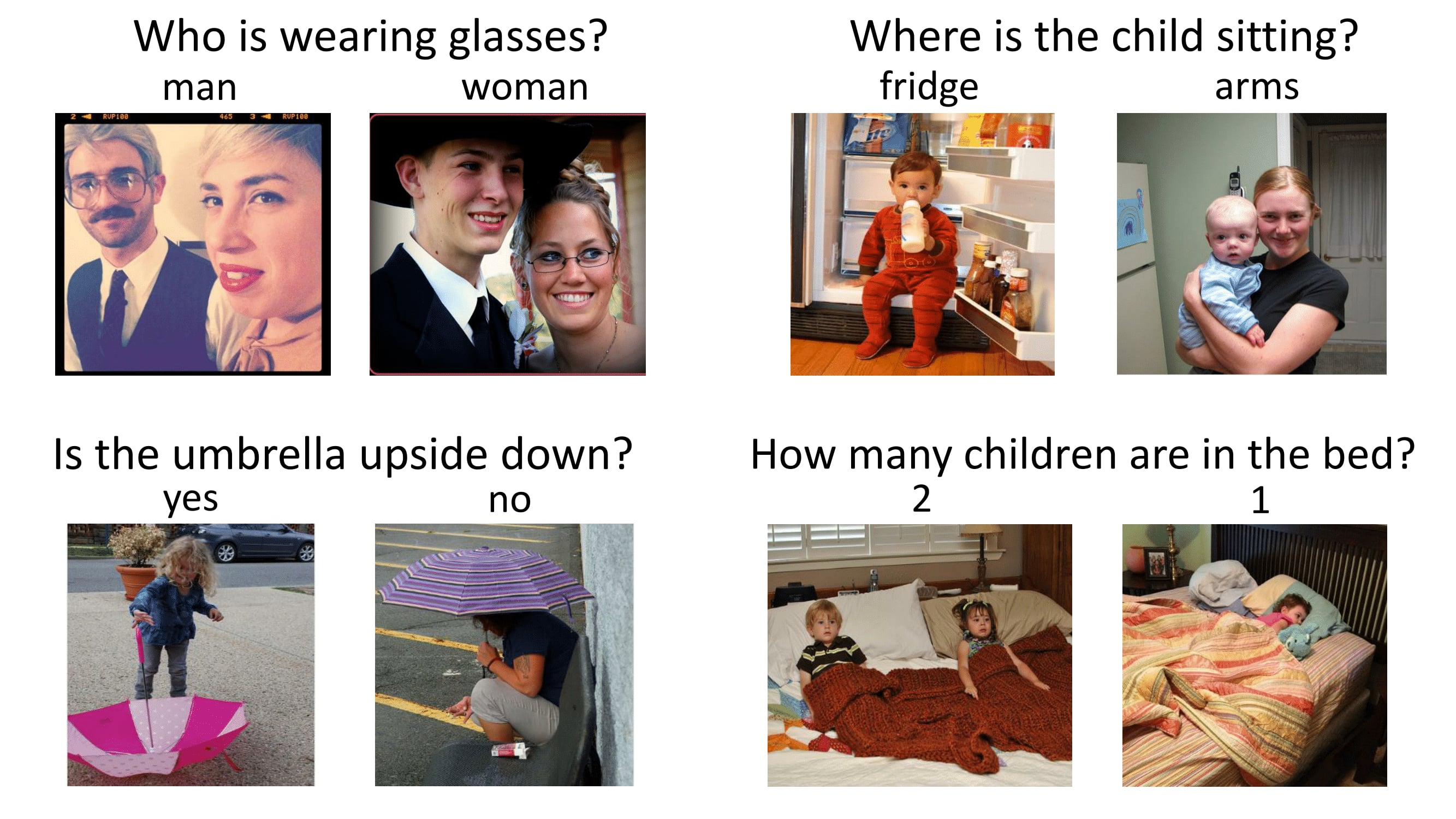
Improving Robustness of VQA Models by Adversarial and Mixup Augmentation — teaser figure

Improving Robustness of VQA Models by Adversarial and Mixup Augmentation

Jurijs Nazarovs, Xujun Peng, Govind Thattai, Anoop Kumar, Aram Galstyan

Preprint · Amazon Alexa AI

Abstract

Recent multimodal models such as ViLBERT and UNITER show impressive performance on vision-language tasks but remain sensitive to subtle variations in input. We propose a novel adversarial objective that incorporates the distribution of possible linguistic variations, and a VQA-specific mixup technique leveraging object replacement, demonstrating improved model robustness on benchmark datasets.

BibTeX
@article{nazarovs2022improving,
  title   = {Improving Robustness of VQA Models by Adversarial and Mixup Augmentation},
  author  = {Nazarovs, Jurijs and Peng, Xujun and Thattai, Govind and
             Kumar, Anoop and Galstyan, Aram},
  year    = {2022}
}

Radial Spike and Slab Bayesian Neural Networks for Sparse Data in Ransomware Attacks

Jurijs Nazarovs, Jack W. Stokes, Melissa Turcotte, Justin Carroll, Itai Grady

Preprint · U.S. Patent

Abstract

A Bayesian Neural Network approach for the cyber-defense domain, designed to handle sparse, class-imbalanced, and size-limited datasets. The method serves as a human-in-the-loop alarming system for detecting potential ransomware attacks.

BibTeX
@article{nazarovs2022radial,
  title   = {Radial Spike and Slab Bayesian Neural Networks for Sparse Data in Ransomware Attacks},
  author  = {Nazarovs, Jurijs and Stokes, Jack W. and Turcotte, Melissa and
             Carroll, Justin and Grady, Itai},
  journal = {arXiv preprint arXiv:2205.14759},
  year    = {2022}
}
Ordinal-Quadruplet: Retrieval of Missing Classes in Ordinal Time Series — teaser figure

Ordinal-Quadruplet: Retrieval of Missing Classes in Ordinal Time Series

Jurijs Nazarovs, Cristian Lumezanu, Qianying Ren, Yuncong Chen, Takehiko Mizoguchi, Dongjin Song, Haifeng Chen

Preprint · U.S. Patent

Abstract

We propose an ordered time series classification framework robust against missing classes in the training data. It relies on a newly proposed ordinal-quadruplet loss that preserves the ordinal relation among labels, and a testing procedure that exploits order preservation in the latent representation — significantly improving prediction of missing labels even when 40% of classes are absent during training.

BibTeX
@article{nazarovs2022ordinal,
  title   = {Ordinal-Quadruplet: Retrieval of Missing Classes in Ordinal Time Series},
  author  = {Nazarovs, Jurijs and Lumezanu, Cristian and Ren, Qianying and
             Chen, Yuncong and Mizoguchi, Takehiko and Song, Dongjin and Chen, Haifeng},
  journal = {arXiv preprint arXiv:2201.09907},
  year    = {2022}
}

2021

Mixed Effect Neural ODE: A Variational Approximation for Analyzing the Dynamics of Panel Data — teaser figure

Mixed Effect Neural ODE: A Variational Approximation for Analyzing the Dynamics of Panel Data

Jurijs Nazarovs, Rudrasis Chakraborty, Songwong Tasneeyapant, Sathya Ravi, Vikas Singh

UAI 2021

Abstract

Panel data — longitudinal measurements of the same set of entities over multiple time points — is common in studies of early childhood development and disease modeling. We propose ME-NODE, a probabilistic model that incorporates fixed and random mixed effects, derived using smooth approximations of SDEs via the Wong-Zakai theorem. We demonstrate its utility on tasks ranging from toy datasets to real longitudinal 3D imaging data from an Alzheimer’s disease study.

BibTeX
@inproceedings{nazarovs2021mixed,
  title     = {Mixed Effect Neural ODE: A Variational Approximation for Analyzing the Dynamics of Panel Data},
  author    = {Nazarovs, Jurijs and Chakraborty, Rudrasis and Tasneeyapant, Songwong and
               Ravi, Sathya and Singh, Vikas},
  booktitle = {Conference on Uncertainty in Artificial Intelligence (UAI)},
  year      = {2021}
}
Graph Reparameterizations for Enabling 1000+ Monte Carlo Iterations in Bayesian Deep Neural Networks — teaser figure

Graph Reparameterizations for Enabling 1000+ Monte Carlo Iterations in Bayesian Deep Neural Networks

Jurijs Nazarovs, Ronak R. Mehta, Vishnu Suresh Lokhande, Vikas Singh

UAI 2021

Abstract

Moving beyond simple Gaussian formulations in deep uncertainty estimation requires Monte Carlo sampling, which scales poorly as data and model dimensions grow. We construct a framework to describe the computation graphs of these estimates and identify probability families where the graph size is independent of — or only weakly dependent on — the number of MC samples, enabling far more iterations with gains in confident accuracy, training stability, memory, and time.

BibTeX
@inproceedings{nazarovs2021graph,
  title     = {Graph Reparameterizations for Enabling 1000+ Monte Carlo Iterations in Bayesian Deep Neural Networks},
  author    = {Nazarovs, Jurijs and Mehta, Ronak R. and Lokhande, Vishnu Suresh and Singh, Vikas},
  booktitle = {Conference on Uncertainty in Artificial Intelligence (UAI)},
  year      = {2021}
}