Robots vs. cameras: when should you use each?
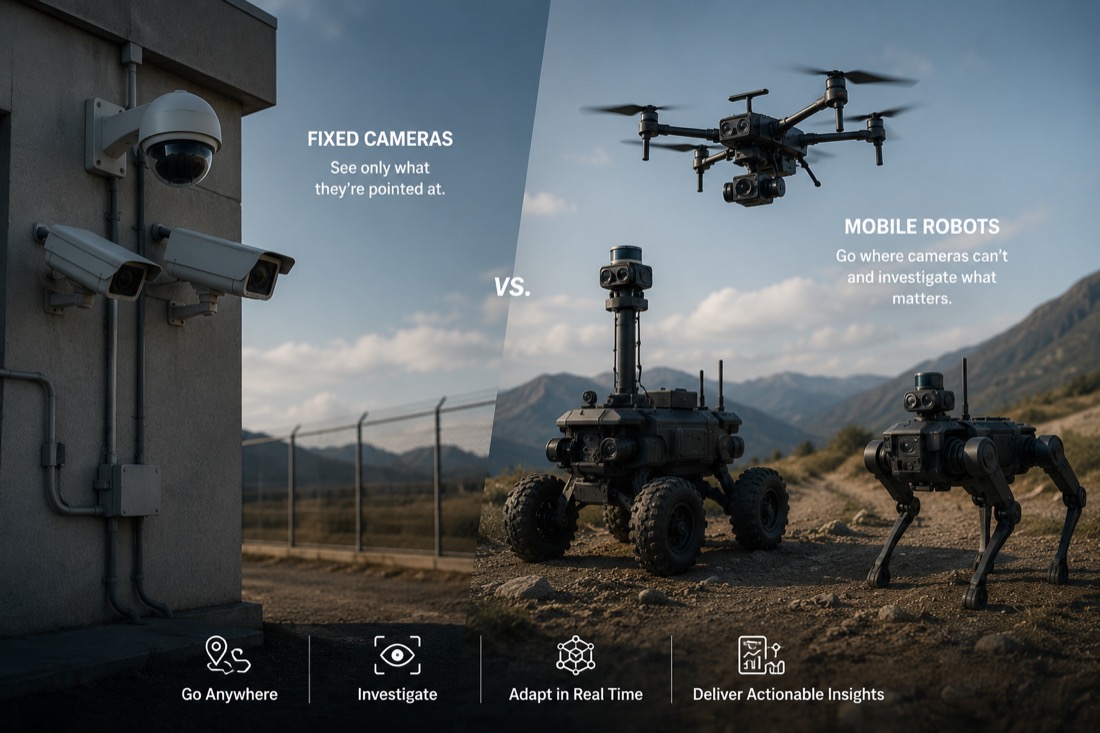
In this post, we assume the robot never manipulates the environment — it doesn't open doors, pick up objects, or perform any physical task. Its only job is to move and observe. In other words, think of it as a mobile camera.
Robot dogs, autonomous rovers, and drones are becoming increasingly popular for security, inspection, and monitoring. It's easy to imagine replacing fixed cameras with mobile robots like these.
But whether the video comes from a fixed camera or a robot, it is typically streamed to the cloud where the same AI models perform detection, reasoning, and analysis. The intelligence is the same.
So if the perception system is identical, why pay for a robot at all?
The answer is that, most of the time, you shouldn't. For offices, warehouses, retail stores, factories, parking lots, and many construction sites, fixed cameras are already inexpensive, simple to deploy, and provide continuous coverage — and if they can already see everything you care about, a robot doesn't add information. It only adds cost.
So when does a robot actually make sense? I believe there are only two situations where mobility creates real value.
The two situations that justify a robot
1. The cameras can't see what you need
A fixed camera can only observe what is visible from its installed position. Sometimes that's not enough. The information you need might be:
- behind an obstacle;
- around a corner;
- under a vehicle or machine;
- too far away for a useful inspection;
- visible only from another angle.
The limitation isn't the AI. The limitation is that the camera simply cannot capture the required view. A robot can — it can move closer, change its viewpoint, look behind obstacles, or inspect an object from multiple angles.
In other words, the robot isn't providing better intelligence — it is providing better access to information. That's what mobility is actually good for: not surveillance, which fixed cameras already do well, but investigation. A fixed camera can tell you that something unusual happened. A robot can help determine what actually happened.
2. Cameras can't be installed
The second case is when fixed cameras simply aren't practical. This usually happens in environments that are too large, too remote, or constantly changing:
- Borders and defense: national borders, defense operations, border patrol
- Energy and industry: wind farms, pipelines, mining sites, remote industrial infrastructure
- Large land and property: agricultural fields, forests, large apartment or gated residential complexes
- Emergency response: disaster response
Could you install cameras everywhere? Technically, maybe. Economically, probably not. Covering these environments would require enormous infrastructure for mounting, power, networking, maintenance, and protection.
A mobile robot changes the economics. Instead of installing thousands of cameras, you move a much smaller number of cameras to wherever information is needed. Different robots solve different mobility problems: a drone can quickly survey a large area, a rover can patrol for long periods, a robot dog can traverse terrain or structures that wheeled vehicles cannot. Together, they become a mobile perception system that can investigate wherever visibility is required.
Even here, the competitor is people, not cameras
Being in one of the two situations above doesn't automatically mean a robot is the right answer. Cameras have already lost that niche, but there's still a competitor waiting: a person who can simply go look.
Today, when something unusual happens, someone usually drives to the location, walks around, investigates, and reports back. A robot can perform that first investigation instead — but only if doing so actually beats sending a person.
In a lot of these situations, a cheap human is good enough. A land manager who already drives the property daily, a guard already on-site, a local worker who can walk over and check — if someone like that is available and inexpensive, they beat a robot on cost and simplicity, every time. The robot only starts to win once human access gets expensive: long travel distances, hazardous or hard-to-reach terrain, remote sites with no staff nearby, or cases where the delay of dispatching a person is itself a cost.
The robot doesn't replace the expert. It replaces the trip — and only when that trip is expensive enough to be worth replacing.
Who will buy these robots?
The first customers are likely to be the organizations that own or run the environments above: defense and border-security agencies, property managers of large apartment or campus complexes, farm and wind-farm operators, mining and energy companies, disaster-response teams. What they all share is the same problem: getting information means physically traveling to the site — and that's expensive.
A simple rule
Choosing between cameras and robots comes down to one question:
Can fixed cameras already provide the information you need?
If the answer is yes, install cameras. If the answer is no, ask why: either the cameras can't see what you need, or they can't be installed where you need them. Those are the only two situations where a mobile robot creates value.